




- WARNING: Frost Tender Variety - Zones 6-8a or colder may harm bulb.
Crinum 'Jagus' arguably has the finest foliage of all crinums, complemented by oversized, striking white blooms. Its exceptionally clean foliage stands more erect than most other crinums, making it especially handsome in garden settings. It blooms once in early summer—occasionally twice—producing flowers with a lovely vanilla fragrance. This variety performs best in coastal regions, though it has been known to thrive as far north as Zone 8a.


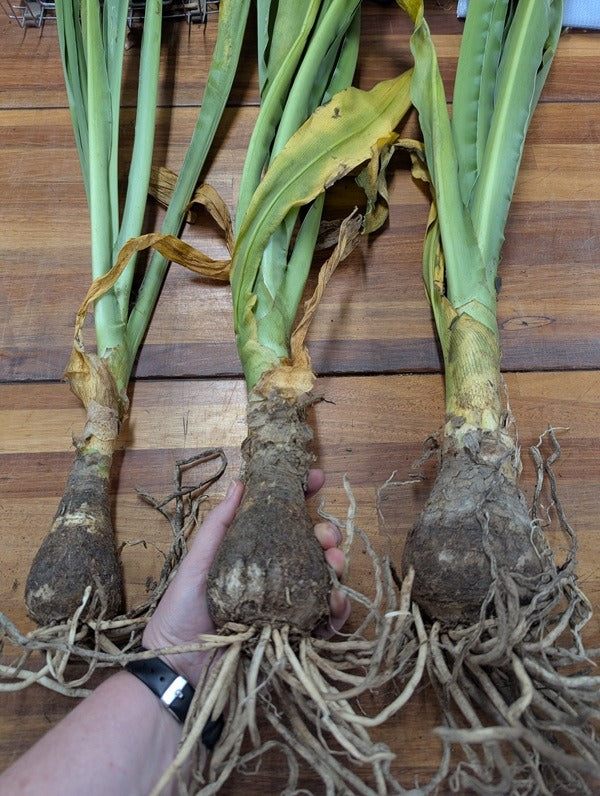
The one in my hand is the regular size
All sizes will eventually produce the same beautiful blooms
Crinums don't like to be moved so they won't bloom for you this year, but give them time to get adjusted and enjoy the display of blooms next year!
| Size | Approximate Bulb Size | Bloom & Growth Notes |
|---|---|---|
| Small | Small bulb | Will take a couple of years to produce good, full blooms; smaller bulbs simply take a bit longer to reach full size |
| Regular | Baseball size or larger | Not yet full size but will produce good blooms; it will begin multiplying sooner than small bulbs |
| Jumbo | Softball size or larger | The most mature bulb available — quickest to reach full size and multiply. |

The Bloom Is Built Differently: Set a jagus bloom next to any other crinum you own and the shape is the first thing you notice. Where most crinums give you a narrow tube, this one opens wide — petals fuller and broader, curling back on themselves instead of staying closed up. It is the rolled-back shape you see in flowers photographed in Southern gardens a hundred years ago. Three to five inches across, and several of them open on the stalk at the same time. They come in June — the month of weddings — and somebody always says these crinum look like they belong in a church: white, full, a little formal, the kind of flower you expect to see somebody carrying down an aisle.

The One You'd Grow for the Leaves: Ask us to name the best foliage in the crinum family and this is the answer. Broad, clean strap leaves that stand up instead of flopping over the way most crinum foliage does by August, and hold their shape through the worst of the summer. It looks like a specimen plant eleven months of the year and a flowering one in June.
A Note from Chris: My two cents on this crinum: it's a special variety that I have longed to offer in larger numbers. Dr. Bill Welch introduced it to me, and the picture above is from his garden. He valued it so much because the foliage stayed so nice and upright — it always was a great landscape plant architecturally, even when it wasn't blooming. That's a rare find in the crinum world. The blooms, although once a year, have an amazing fragrance, and their tulip-shaped form is special. My one concern for you is that it can be cold sensitive. Mulch it during the winter months: after the foliage has died down after the first frost, just grab a large sack of potting soil from Lowe's or Home Depot (or The Arbor Gate if you are in Houston), cut the bag open, and dump the entire contents on top of the clump. That's all the protection we need here in Tyler. We hope you enjoy this special treat. —Chris

Come Out in the Evening: The fragrance is light and vanilla-sweet, and it carries best after the sun goes down. Worth planting where you already walk — along a drive, near a porch step, beside a gate.

Planting: Plant the crinums with the tip of their neck right at or barely above soil level. Plant in well-drained soil. Crinum can take full summer sun, but if you have a little shade during the late afternoon, that would be great. Crinum perform best when they have at least 8+ hours of sun every day.
Know Your Zone: This is a frost-tender one. Happiest in Zones 8–10, and it does its best work in coastal gardens. We have seen it hold up as far north as 8a; below that, a hard freeze can take the bulb. If you're outside the range and want it anyway, grow it in a large pot you can pull under cover.
History and fun facts: Crinum jagus is a West African species, known in much of the world as the St. Christopher lily. Bulbs of it reached England in 1792, sent up from Sierra Leone, and what followed was about a hundred and fifty years of European botanists arguing over what to call it. One filed it as an Amaryllis. Another renamed it Crinum giganteum — the old catalog name some longtime gardeners still know it by. In 1806 the Botanical Magazine ran a picture of it labeled as a white form of something else entirely. By 1860 the same magazine gave up and admitted the plant had "been long known in England, but much misunderstood" — and that the African name was the better one anyway. The botanists finally made it official in 1939. Jagus is what West Africa had been calling it the whole time.