


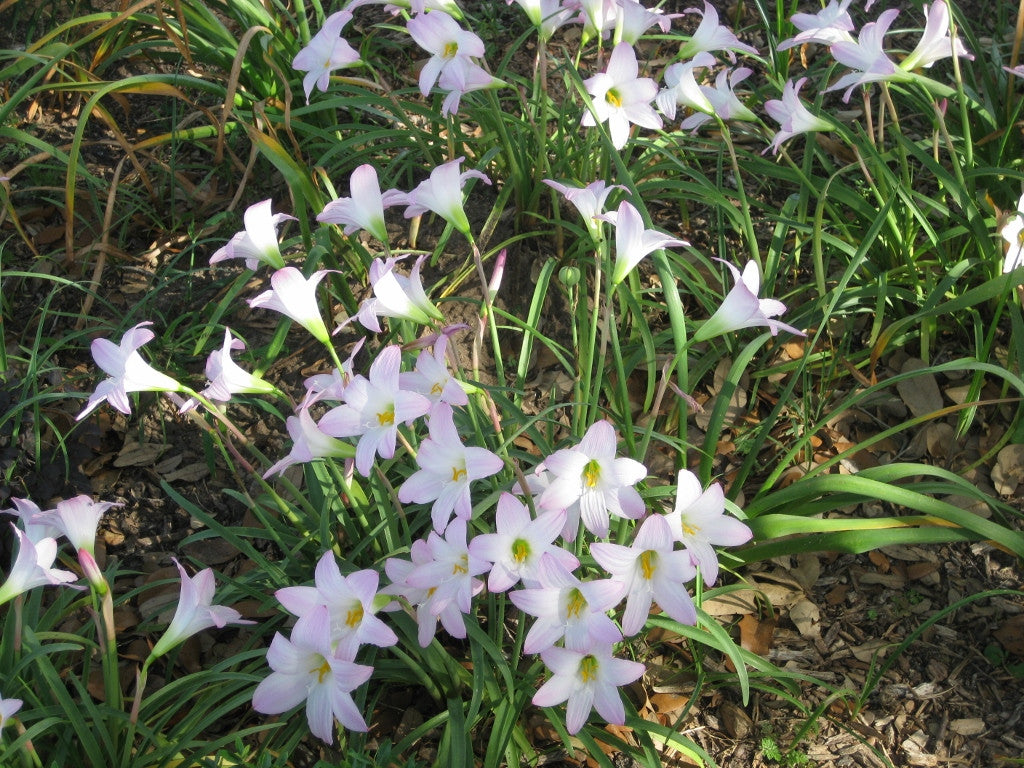
Pink Rain Lilies in 4" Pot
Each pot contains multiple pink rain lily bulbs (Habranthus robustus) and will be shipped in their pots. When the box arrives, open and water immediately. Habranthus robustus multiply quickly by seed or multiplication.
There are many rain lilies that bloom all across the world, but few put on the show of Habranthus robustus. This pink rain lily will bloom 4 to 6 times in one summer, not minding the heat or humidity. They can be seen performing in shady areas and in full sun. These larger rain lily bulbs quickly clump and spread, offering a showy display in an otherwise dormant summer garden. The light pink showy displays make great borders often seen from afar.

Every May and June, the Habranthus pink rain lilies begin to really take off! When they are finished blooming, large seed pods will form. These seeds can be sown directly in the garden and very quickly lead to a healthy population in the garden! Don't worry, they are not considered invasive and can be easily removed if needed.
Where to plant: These are extremely resilient. Even though the blooms are large, the bulbs are fairly small. You can plant them....
- in cracks in pavement and brickwork with a little soil
- in that little bit of soil that is between the sidewalk and driveway that bakes in the summer
- under live oaks, pecans or other big shade trees around the dripline where most bulbs hate competing with the big roots
- in cemeteries or locations that don't have irrigation
- around mailboxes or lamp posts where you want something alive
- in containers or porches as they do great in pots

The light pink showy displays make great borders often seen from afar. Rain lilies aren't blooming individually after a storm — every bulb in a colony responds to the same trigger at roughly the same time. That's why an established patch can put up dozens of flowers within a few days of a rain event. It's also why a single isolated bulb is far less impressive than a clump — these are plants that want to be planted en masse. A single bloom typically lasts only 1–3 days before fading. The "show" effect comes from many flowers opening over the course of a week, with a few late stragglers trailing for another week or so after that. The bulbs themselves, though, are remarkably long-lived — colonies in old cemeteries and homesites have been documented persisting 80+ years with no care.

Collecting these seeds led to one of my first dates with my wife! What do you do on a date with a girl these days? Movies are so expensive, or at least the popcorn and drinks are expensive. Only so many nights can be spent eating out, and after you've done Chinese, Mexican, sushi, American, drive in, dine in, and take-out you're out of ideas. Well, if you're the Bulb Hunter, you ask your girl to put on her blue jeans and go collect rain lily seeds with you. That is what Rebecca and I did on one of our first dates many years ago. I wish the weather had been nicer (it was blistering hot) but she must have had a good time because that was just the beginning of our exciting journey! That heat also speaks to another quality of the flower...they will bloom even during some of our hottest summer months.

This pink rain lily will multiply by bulb and by seed which means your garden will be filled quickly. Later in the season, they will put on little seed pods. Each pod is filled with lots of papery seeds. We don't count the seeds as there are too many, but trust us, there are A LOT! You can scatter them directly where you want more bulbs, scratch them into the soil, and you will often see growth in a couple of years. Or do nothing at all and let the colony self-sow on its own — that's how a single clump becomes a drift. These aren't invasive as you can easily dig them or just let them get thick to really fill in an area.

Color: Many often wonder why they should have more than one kind of pink rain lily in their garden. We love having the Habranthus robustus, Zephyranthes labuffarosa, and the Zephyranthes grandiflora together. When comparing the Zephyranthes grandiflora to our other popular rain lily, Habranthus robustus, think about these differences:
1) The Zephyranthes grandiflora and Zephyrathes labuffarosa bloom with an open, star-like look, while the Habranthus robustus has a more trumpet, elongated bloom.
2) Blooms on a Z. grandiflora are so vibrant they're almost an iridescent blend of pink and purple, with maybe even a hint of blue. The Zephyranthes labuffarosa are a lighter pink than the grandiflora, though not quite as pale as the Habranthus, while the H. robustus are a very light, soft pink. Planted together, the three give you a lovely gradient of pink — deepening from the palest blush of the robustus, through the gentle rose of the labuffarosa, to the rich, almost iridescent bloom of the grandiflora.
3) Foliage on the Z. grandiflora is darker green and smaller, while the H. robustus foliage is a paler and flatter green foliage.
4) The Zephyranthes grandiflora and Z. labuffarosa are shorter than the Habranthus robustus and that makes for a great layering in your garden.
5) The H. robustus begin to bloom in April/May, and the Z. grandiflora and Z. labuffarosa blooms the first of June and continues during the heat of the summer. Their bloom-time overlaps for several weeks during the end of May and June so you get a stunning combination from flowers with complementary characteristics to help create a harmonious and appealing design.
Looking for more rain lilies? Be sure to check out our full collection of rain lilies here!