


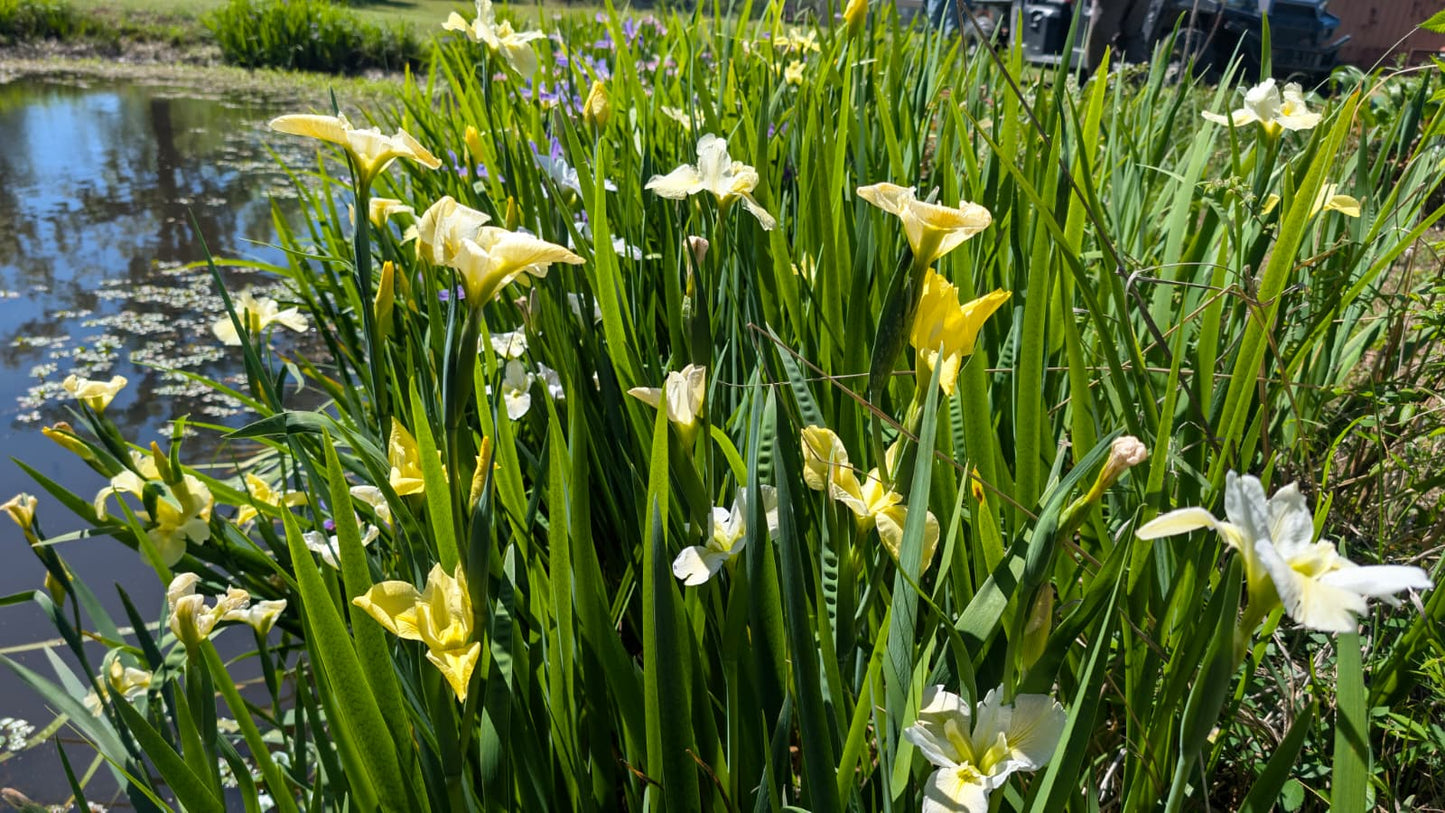
These Louisiana irises (Iris series Hexagonae) come to us with a rare and special pedigree: they were given to us by the late Ryan Gainey, the celebrated Decatur, Georgia garden designer, plantsman, and author whose eye for heirloom and passalong plants made his gardens legendary throughout the South.
These irises have proven themselves the way only time can — multiplying, thriving, and settling into the boggy conditions they love best. Their flat, open flower form is unmistakably different from the upright standards of bearded irises — elegant, graceful, and built for the Gulf Coast climate. Native to the swamps and wetlands of Louisiana and the Gulf South, these irises thrive in heat, humidity, wet feet, and even standing water — conditions where bearded irises simply can't compete.

Southern Bulb Iris History: Ryan Gainey (1944–2016) was one of the American South's most beloved and influential garden designers — a plantsman, author, and tastemaker whose cottage-style garden in Decatur, Georgia became a pilgrimage site for gardeners across the country. Raised in rural South Carolina, Gainey had a deep reverence for the old Southern tradition of passalong plants: heirloom varieties shared hand-to-hand across generations, carrying with them the stories of the gardeners who grew them. His own garden, tucked behind a converted 1900s farmhouse and greenhouse, was a layered tapestry of roses, perennials, bulbs, and unusual specimens that inspired books like The Well-Placed Weed (1993) and the PBS documentary The Well-Placed Weed: The Bountiful Life of Ryan Gainey.
Louisiana irises were a signature feature of Gainey's pondside plantings, where he let them naturalize freely at the water's edge in the loose, romantic style he was famous for. What you're receiving is the same passalong tradition Gainey himself championed. To plant them is to continue his story.


Blooms: Louisiana iris blooms are large, flat, and open-faced — usually 4 to 6 inches across — with a graceful, almost orchid-like elegance that sets them apart from the upright, ruffled form of bearded irises. They appear in mid to late spring on tall, slender stems that rise well above the foliage, often carrying several blooms per stalk that open in succession over several weeks. The color range is extraordinary, spanning creamy whites and soft yellows to lavenders and deep purples. Many varieties feature a bright yellow "signal" at the base of each petal — a landing pad that glows against the darker petal color and draws in hummingbirds, bees, and butterflies.


Planting: Set the rhizomes shallowly — with the top just at or barely below the soil surface — and space them about 12 to 18 inches apart in rich, slightly acidic soil that stays consistently moist. They need at least 6 hours a day of winter sun, but they thrive in full winter sun (8-10 hours a day), and they absolutely love wet feet, making them perfect for pond edges, low spots, rain gardens, or any bed with reliable moisture.
Pots: The good news: Louisiana irises don't have to live in water. They'll thrive there, but they're a lot more flexible than their reputation suggests. They'll grow just as happily in regular garden soil, in containers, in large tubs, raised beds, half whiskey barrels, or even old irrigation tanks. Just remember: they spread by sending out new rhizomes each year, so give them room to stretch. A tight little pot that fits one rhizome today will feel cramped by next spring.
Water deeply after planting and mulch 2 to 3 inches deep to protect the shallow rhizomes from sunscald and to help retain moisture through their first season. Once established, they'll multiply steadily and reward you with years of spring color.

Watering & Mulch:
If you decide not to plant these at the pond's edge or in standing spring water, you'll want to water, water, water.
Louisiana irises love moisture, and great blooms depend on it. The whole show depends on keeping those beds consistently moist once new growth begins.
The rule is simple: don't let them dry out. Know the dry stretches in your area and give the iris beds a good, deep soaking at least once a week during those periods. Adjust as the plants grow and the weather shifts.
Mulch is non-negotiable. It holds in moisture, smothers weeds, and feeds the soil as it breaks down. All good things. But in summer, mulch does one job that nothing else can do — except planting your irises in actual water.
Here's the problem: Louisiana iris rhizomes sit right at or just below the soil surface. Once the foliage dies back in summer dormancy, those rhizomes are exposed to the full blast of the Southern sun. The result is sunscald — the rhizome turns mushy, rots out, and while the tip may push out a little new growth, you can almost guarantee no blooms next spring.
The fix is easy: cover them up. Two to three inches of rotted or semi-rotted leaves, pine straw, bagasse (sugarcane fiber), or cotton burr compost will all do the job beautifully. In a pinch, even a half-inch of soil is better than nothing. Just protect those rhizomes from the summer sun.
Mulch year-round if you can. In colder areas, winter mulch is essential too. Use whatever you've got on hand or whatever's cheap and available locally — the irises aren't picky.

Foliage: Louisiana iris foliage is long, sword-like, and bright green, typically reaching 24 to 36 inches tall and forming graceful, upright fans that are handsome in the garden even when the plants aren't in bloom. Unlike many irises, Louisianas have a reversed growth cycle in the Deep South — new foliage emerges in fall, grows through the winter months, and is lush and full by the time spring bloom arrives. After flowering, the leaves often yellow and die back during the heat of summer as the plants go dormant, so you have easy access to the low areas or pond's edge. In cooler climates or shadier, moister spots, the foliage may persist longer into summer before fading. Come fall, fresh green fans push up again, and the cycle begins anew.

Landscape and Maintenance: Louisiana irises are at their best when planted in masses or drifts rather than as single specimens — their tall, architectural foliage and bold spring blooms make a striking statement along pond edges, in rain gardens, beside streams, or in any low spot where moisture collects. They pair beautifully with other moisture-loving plants like Louisiana phlox, swamp hibiscus, cardinal flower, and canna, and their summer dormancy is easily disguised by interplanting with summer perennials such as daylilies, ginger lilies, or swamp sunflowers that fill in as the iris foliage fades. For maintenance, keep the soil consistently moist throughout the growing season — never let them dry out in fall, winter, or spring — and feed lightly in late fall and again after bloom with a balanced, slightly acidic fertilizer. Mulch 2 to 3 inches deep to protect the shallow rhizomes from sunscald and retain moisture, but take care not to bury the rhizomes themselves. Divide clumps every 3 to 4 years in late summer to keep them blooming vigorously, and remove spent flower stalks and yellowed summer foliage to tidy the planting and discourage disease.

History and fun facts: Louisiana irises have a rich and distinctly American story. They are one of the few iris groups native to North America, growing wild in the swamps, bayous, and ditches of Louisiana and the Gulf Coast, and they are in fact the official state wildflower of Louisiana. The five native species were largely unknown to the gardening world until the 1930s, when Dr. John K. Small of the New York Botanical Garden began exploring the Louisiana swamps and documented what he called "the greatest iris show on earth," sparking national interest in these previously overlooked natives.
A final bit of lore: the bright yellow "signal" at the base of each petal is thought to have evolved specifically to guide hummingbirds to the nectar, making Louisiana irises one of the few irises pollinated by birds rather than bees alone.
