


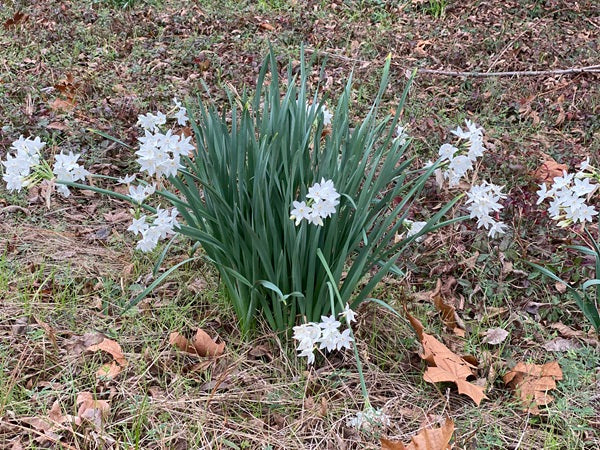
Narcissus tazetta papyraceous
Old fashioned paperwhites bloom anytime from Thanksgiving to January across the Southern United States. Some years they are spectacular, and others they are not. Sometimes you'll be waiting for a bloom and a blue norther will come through and freeze the buds (the plants themselves will be fine...it can be disappointing!) However, some years they do exactly what you want them to do and they give you a winter show you've been waiting for. We offer a mixture of bulb sizes of paperwhites collected from many different old locations - they generally bloom on the same schedule. We hope you enjoy!
Did you know there used to be many, many different historic types of paperwhites? At least I've been told that, but now we're down to about 4-5 main varieties that are primarily used for forcing. (Forcing is where you can plant them in pots or in the ground and have them bloom about 5 weeks later, enabling you to time them for special occasions like Thanksgiving, Christmas, or New Year's celebrations.)

The older varieties, though, can still be found in older gardens or abandoned homesites. Here's how they differ:
- They generally bloom from late November through the first week of January.
- They aren't as compact. They're more of a free-flowering, clumping form of garden flower — don't plan on them standing at attention and blooming compact blooms like forced paperwhites do.
- You treat them like perennials and let them follow the same path as daffodils in your garden (they're both in the genus Narcissus) — meaning you let the foliage live and die down naturally, so you'll have greyish-green foliage through May of the next spring.

I mention all this so you know to treat these like garden perennials, not as florist-quality annuals in a showy pot or entryway to your house. Mix them with other winter-blooming bulbs like 'Grand Primo,' campernelles, and snowflakes, and plant them with perennial shrubs like salvias, plumbago, or lantana. Let the winter-blooming old-fashioned heirloom paperwhites fill the late November/December gap in perennial garden blooms, and use the fall forcing paperwhites for more formal pot combinations or annual color change-outs in the areas closest to the home.

These are a Southern gardener's dream (zones 8-11!). Paperwhites are native to the western Mediterranean — Spain, Portugal, southern Italy, North Africa — places with mild wet winters and hot dry summers. Sound familiar? It's essentially the climate of the Deep South, the Gulf Coast, coastal California, and warmer parts of Texas. Plant them here and you're giving them exactly what they evolved for. Even better, they bloom in early winter, filling that quiet gap when almost nothing else in the perennial garden is doing anything at all.

The scent controversy: Here's a fun bit of science behind that famous fragrance: paperwhites contain a compound called indole — the same chemical found in jasmine and orange blossom (and, in higher concentrations, in decay). At low levels indole reads as sweet and floral; at higher levels it tips into something funky and animalic. This is why people are so polarized about paperwhite smell — some find it heavenly, others say it's not so great. Both reactions are chemically valid; your nose is detecting real compounds, just interpreting them differently.
Outdoors, though, the whole conversation changes. In open air, the heavier indole notes dissipate quickly and what's left is the sweet, floral side drifting on the breeze. No four walls to trap it, no overwhelming the dinner table. Just a beautiful surprise of fragrance as you walk past on a December morning — exactly the kind of unexpected gift a winter garden should offer.

These are true heirlooms — no fancy variety name, just an old-fashioned strain we've been growing at the farm for several years. The kind of paperwhite that, once planted, sticks around.
They multiply. A single bulb develops into a substantial clump within 3-5 years, and those clumps keep expanding and blooming faithfully for decades. This is why you find them still going strong at homesites where the house disappeared generations ago.

Planting: Plant the bulb like most daffodils in 6+ hours of winter sun, well-drained soil, avoid standing water, and avoid too much competition. Plant the bulbs about 2-3 times the height of the bulb deep (so if the bulb is 1 inch tall, plant it 2-3 inches deep). If you are farther north and get very cold during the winter, you may want to plant it about 4-6 inches deep. Space the holes about 3-6 inches apart, and for a more natural looking display, consider planting 2-3 bulbs in each hole.
When to Plant: You can wait, but why would you? Plant them now and let the ground protect them (plus, you won't forget about them). The bulbs are dormant, but planting them now gives them time to settle in before sending up blooms this coming winter. If you really want to wait until the fall, you can. Just keep them in a location out of direct sunlight where the air can flow around them.

Animals: Nothing eats them. Like all narcissus, paperwhites are toxic to deer, squirrels, voles, rabbits, and gophers. Plant them and forget the critter worries — this is a big part of why heirloom clumps persist for a century or more.