


Peonies are heirlooms in flower form. Plant one and the same root will still be blooming for your grandchildren — sometimes better at fifty years old than it was at five. Each spring, peonies pull off something no other perennial can: huge, blowsy, almost-too-much blooms saturated with that old-fashioned fragrance you remember from a great-aunt's garden. They're deer-resistant, drought-tolerant once established, and ask almost nothing in return. Few plants give you more for less.
Festiva Maxima is the white peony your grandmother grew. Introduced in France in 1851, it has been a garden favorite for more than 170 years and holds the Royal Horticultural Society's Award of Garden Merit. Big, fully double, ruffled pure white blooms carry a few flecks of crimson tucked into the center petals, and the fragrance is sweet and rich. If you only plant one white peony, this is the one.

Why It Works in Zones 7–8: Yes, it comes back. Festiva Maxima is a true perennial in zones 7–8, returning every spring from the same root. We've grown it in our own East Texas garden (zone 8) for years, where it blooms right alongside our Byzantine gladiolus (pictured below). Most peonies struggle where winters are mild, but Festiva Maxima is one of the few that does well. It is an early bloomer, so it flowers before the real heat arrives, and it is often called the best double peony for warm-climate gardens. Peonies do need some winter chill, so for the best chance of success as a perennial, we suggest you garden roughly along I-20 or north. Plant it shallow (see Planting below), give it some afternoon shade, and it will reward you for decades.

(Festiva Maxima blooming with Byzantine gladiolus on the south side of Chris's house.)
Blooms: Pure white, fully double, five to seven inches across, with small crimson flecks on a few of the inner petals. Strongly fragrant. Early-season bloomer on stems 32–36 inches tall — a long-lasting cut flower for the vase. The blooms are heavy, so a peony ring or stake could help keep them upright after a rain, especially in part shade — but Chris's do just fine without one. Deer and rabbit resistant.

Bloom time by zone
- Zone 8: Late April to early May
- Zone 7: Early to mid May
- Zones 5–6: Mid to late May
- Zones 3–4: Early June
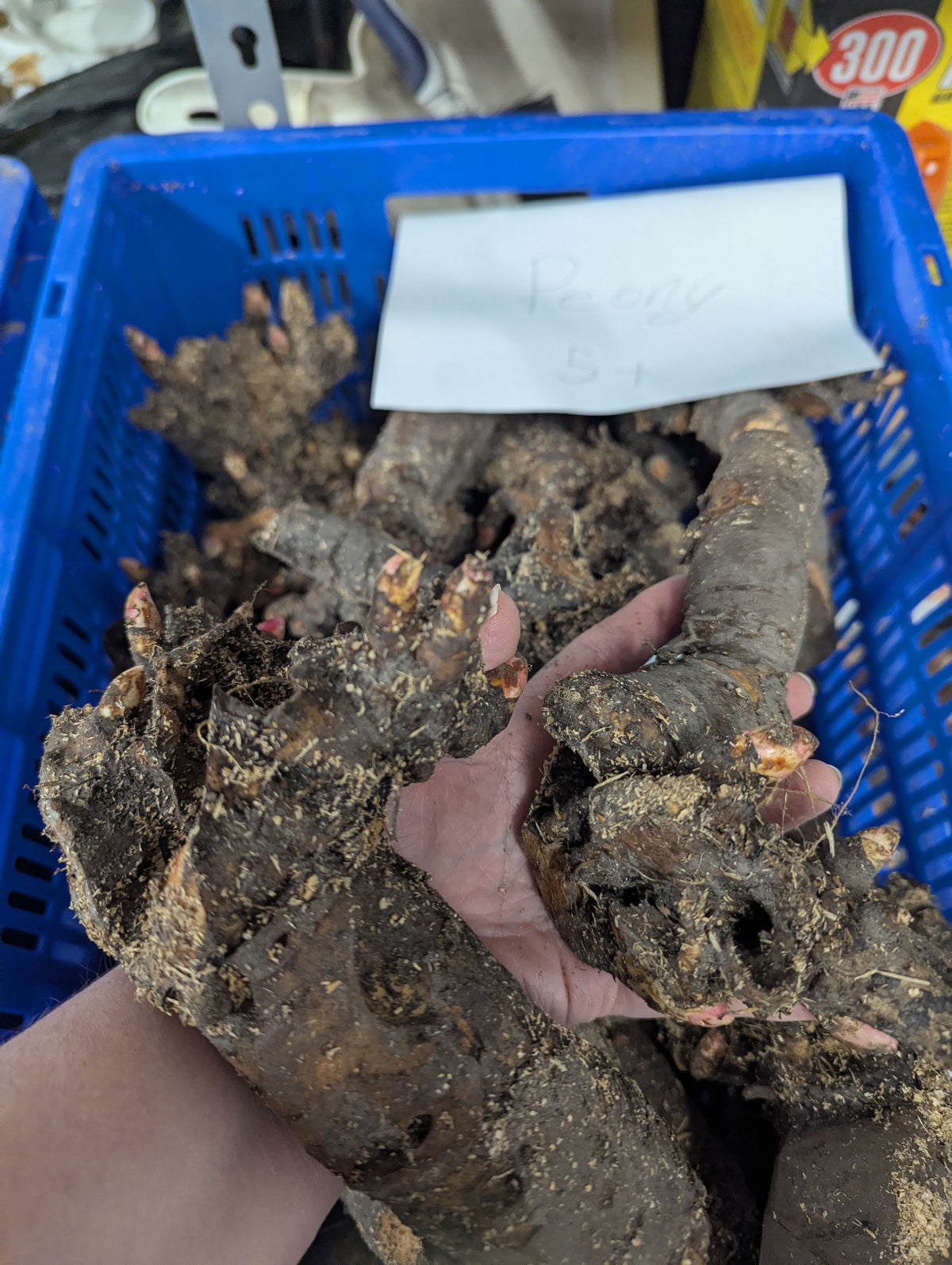
Root Sizes: We offer two sizes, and the name tells you how many "eyes" are on the root. Eyes are the plump buds on top of the crown (cream to pink in color) that become next year's stems. More eyes means more stems, and more stems means more blooms, sooner.
3–5 eye root: A healthy, standard division with three to five eyes, about the size of your hand. This is the size most nurseries sell, and it will settle in and fill out into a full bush over a few seasons.

(A 3–5 eye root. The creamy buds on top of the crown are the eyes.)

(A handful of our 3–5 eye roots, straight from the crate.)
5+ eye root: A bigger, more mature crown with five or more eyes. These are noticeably larger and heavier, and they get a head start: more stems the first spring, a fuller bush faster, and a heavier bloom sooner.

(A 5+ eye root. Count the pink eyes all along the crown.)

(Our 5+ eye roots, straight from the crate.)

(A mature bed of Festiva Maxima in Chris's garden, so you can see how the bushes fill in.)
Planting: This is where most gardeners in zones 7–8 go wrong. Peony "eyes" (the pink buds on the crown) need a winter chill to set flowers. In zones 3–6, you plant the eyes about 1.5 to 2 inches below the soil surface so they're insulated from hard freezes.
In zones 7 and 8, you do the opposite: plant the eyes only about ½ to 1 inch below the surface. Planted any deeper in warm soil, the crown stays too warm, and you'll get gorgeous foliage but no flowers — sometimes for years. This is the most common reason peonies "fail" in zones 7–8.
We suggest you get these planted ASAP, while the ground is still cool — that will help the root crown get established this year.
SOIL: Rich, well-drained soil is non-negotiable — peonies will rot in soggy ground. Amend with compost, aim for slightly acidic to neutral pH (6.5–7.0), and avoid planting near trees or large shrubs that will compete for water and nutrients. Space plants 3–4 feet apart; good air circulation prevents botrytis, which is more of a problem during humid summers in zones 7–8.

(Festiva Maxima blooms and foliage in Chris's garden.)
Sun: Peonies want full sun — at least six hours daily — to bloom well. In zones 3–6, give them all the sun you've got.
In zones 7–8, plants benefit from a spot that gets full morning sun and a bit of afternoon shade, especially in July and August. The light shade doesn't reduce flowering meaningfully, and it dramatically extends bloom life (flowers fade fast in 90°F sun) and reduces heat stress on the foliage.
Watering: Once established, peonies are fairly drought tolerant. The general rule is deep watering about once a week during active growth and bloom, tapering off after flowering. The zone difference here is real: in zones 3–6, natural rainfall often does most of the work. In zones 7–8, you'll need to water more attentively from late spring through summer, especially during dry spells, because heat drives evaporation and stress. That said, never let them sit wet — soggy crowns invite rot. Drip irrigation or soaker hoses are ideal; overhead watering encourages fungal issues.
Foliage: The foliage begins to appear in mid-spring and will last until the first hard frost (5–6 months in zones 3–6, 6–8 months in zones 7–8). Red shoots will emerge in early spring. These turn into fully developed lush green foliage by bloom time. They remain dense and attractive all summer. In the fall, the foliage turns a lovely gold-bronze color, and it dies back completely after the first hard frost. Not evergreen — the plant disappears underground in winter.

Landscape and Maintenance:
Mulch: In zones 3–6, a 2–4 inch winter mulch protects crowns from freeze-thaw cycles — apply after the ground freezes and pull it back in early spring. In zones 7–8, use only a thin summer mulch (an inch or two) to keep roots cool and conserve moisture, and keep it pulled back from the crown itself. Heavy winter mulch in zones 7–8 works against you because it traps warmth and reduces the chilling the plant needs.
Expectations: Don't fertilize heavily, and don't expect blooms the first year — peonies put their energy into roots before flowers. Year two usually brings a few blooms, and by year three the plant hits its stride. Patience is part of the deal.

(This is not Festiva Maxima — just a picture of established peony bushes so you can see what a few years of patience looks like.)
History and Fun Facts: Festiva Maxima was introduced in 1851 by the French grower Miellez, and old American nursery catalogs from the early 1900s list it again and again as the most popular early white peony you could buy. Peonies themselves are named after Paeon (or Paean), physician to the gods in Greek myth. The story goes that Paeon was a student of Asclepius, the god of medicine, and used a peony root to heal Pluto of a wound inflicted during the Trojan War. Asclepius grew jealous of his student's success and plotted to kill him, but Zeus saved Paeon by transforming him into the peony flower. The plant has carried his name ever since — Paeonia — and the English word "paean" (a song of praise or triumph) shares the same root.