


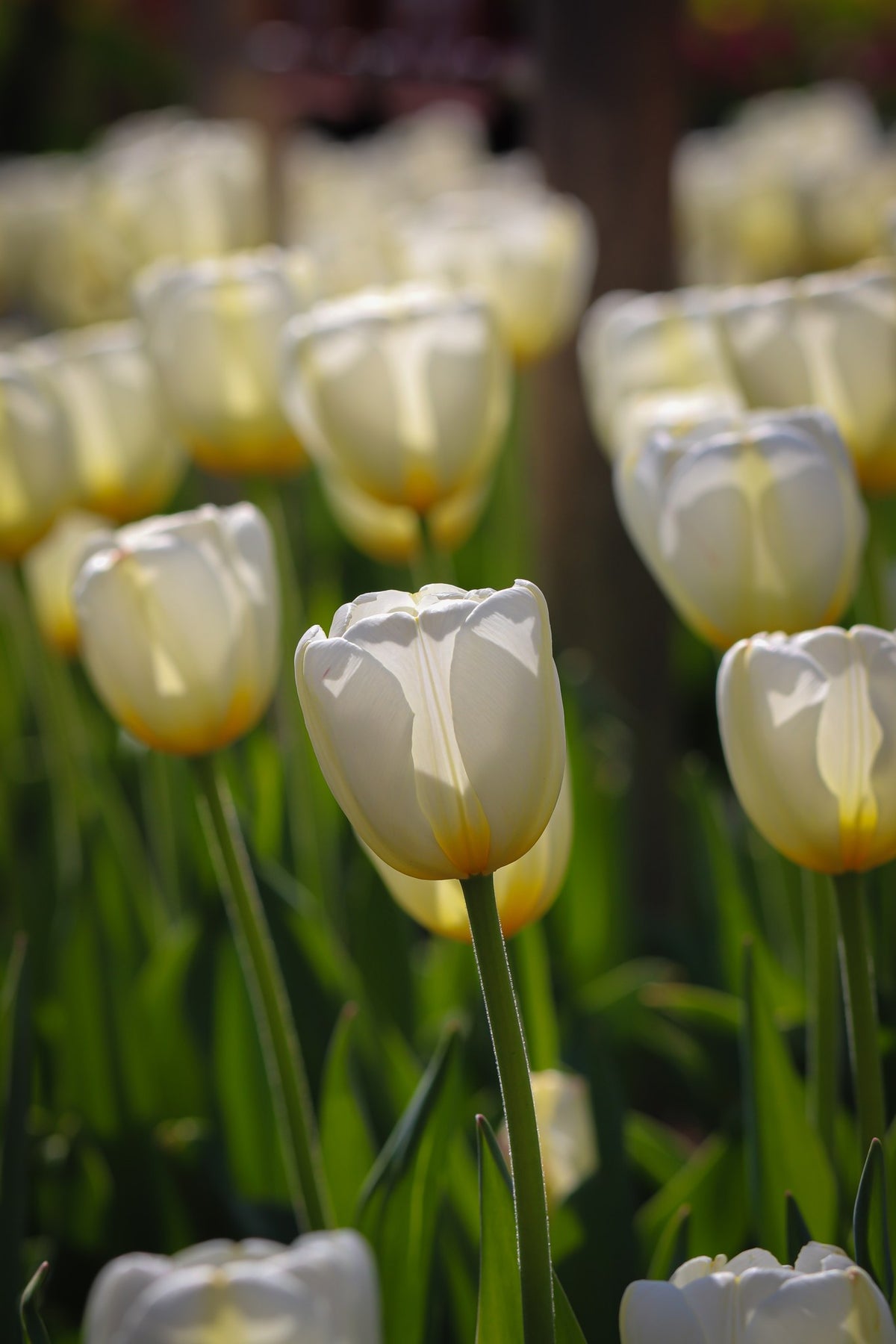
Provides a lovely, single- year bloom (not perennial).
Pre-chilled bulbs! Ready to plant!
Tulips are recognized the world over for their beauty and bright colors welcoming the spring after a long winter. There is absolutely a place in your garden for the larger hybrid tulips, like the 'Van Eijk', but you need to plan on treating those as annuals and plant them every year. The value of tulips in your garden is immeasurable! 'Catherina' is a stately Single Late tulip with extra-large, egg-shaped blooms in creamy white, with broad ivory petal edges, a buttercup-yellow base inside, and dark yellow anthers. The blooms fade to nearly pure white as they age — a magnificent late white.

What to expect: A late-season tulip on tall 22-24″ stems, opening after most early tulips and daffodils have finished to stretch your spring show. Hardy in zones 3-8.

Care and planting: Plant them and enjoy them. They prefer full sun but will do well with a little spring shade. Plant the bulbs about 3x the height of the bulb deep and the space apart only depends on how natural you want your area to look. Then dig them up when they are done performing. If you are going to plant it immediately, the bulbs do not need to be stored in the fridge. Just go ahead and plant it. However, if you are going to wait a few days or even a couple of weeks, then keep the bulbs in the fridge. The creamy-white blooms look amazing planted with anything, and they glow at dusk.
Sunlight: Plant the tulips in full sun. Tulips are heliotropic which means that the blooms bend, move, arc and twist themselves throughout the day in order to be in the best position to receive light. They reach for it. They even do this once you have cut them and bring them into the house. That is why you may want to consider moving the vase around the house throughout the day. Tulips are also photonastic which means that the blooms close up at night and reopen during the day.
Blooms: The blooms will last well for a couple of weeks, but an unusually hot spring will make the blooms droop. Tall stems make 'Catherina' an excellent cut flower.
History: Most people think of Holland when they think of tulips, and Holland is the largest producer of tulips. But did you know that tulips originally came from the mountains near Afghanistan and Kazakhstan? The tulip then moved toward modern day Turkey where it received its name "tulipan" which means turban. There is some disagreement over the origin of the name. The name is either because the shape of the flower looks like a turban or because sultans would stick a tulip in their turban to show their power and wealth. A very powerful sultan in Turkey would give his guests gifts of tulips. That is how around the late 1500s the tulip made it to Holland. Tulip bulbs were used in place of money and stolen out of gardens. In Holland in the 1630s, a handful of tulip bulbs was worth about $44,000 according to the Old Farmer's Almanac, and a single tulip bulb could buy an entire canalhouse in Amsterdam.
Fun facts: Tulips generally symbolize deep and perfect love. Striped tulips were greatly prized for centuries. Though not known until 1931, striped tulips were originally caused by a virus that was spread by aphids. If you ever wanted to travel to Holland, try to arrange your trip for April or May when the Keukenhof gardens, the largest tulip garden in the world, has more than 7 million tulips in bloom. Tulip bulbs have been eaten during times of famine. During the particularly harsh winter of 1944-45 in the Netherlands during WWII, the government published recipes on how to make tulip soup and tulip flour for bread. Though we don't recommend it, even actress Audrey Hepburn ate tulips with her family during this time in the Netherlands.